
How to Cook a Turkey Perfectly
How to Cook a Turkey Perfectly
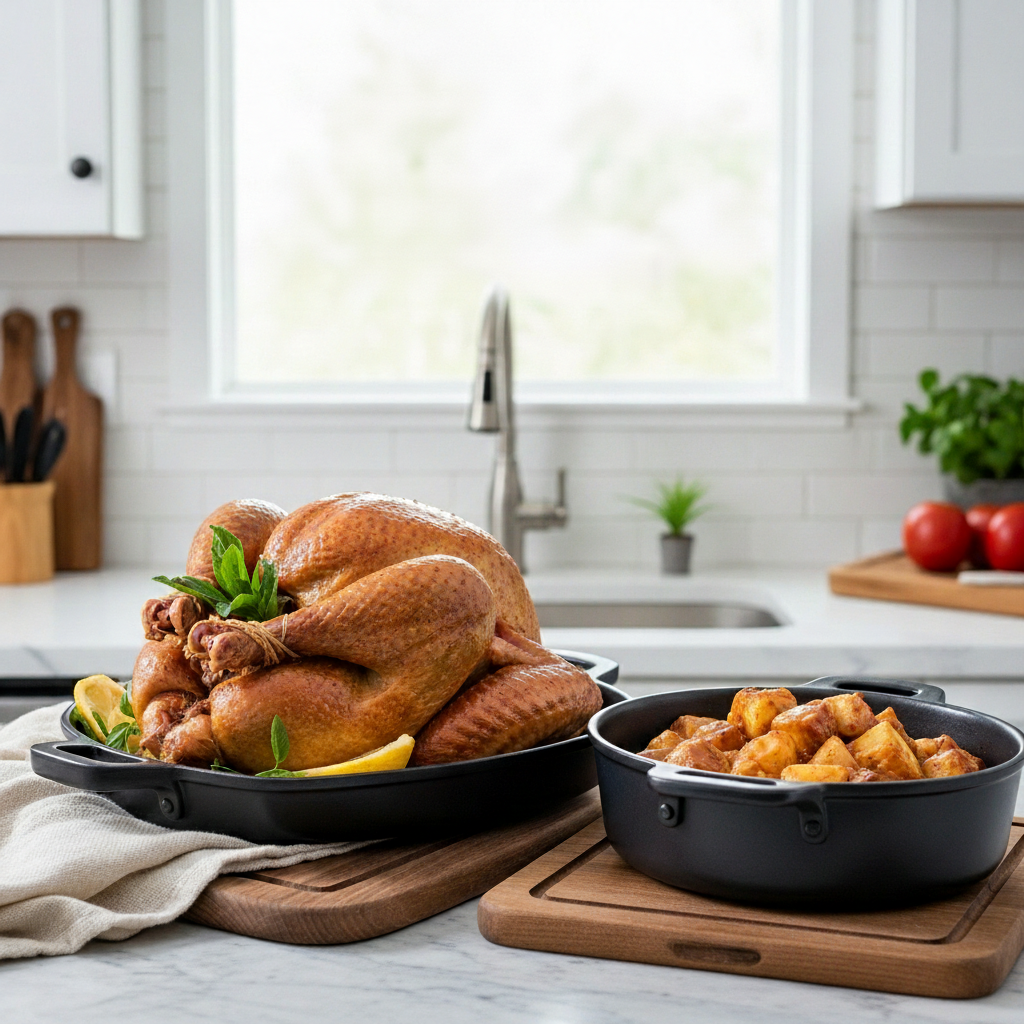
A beautifully roasted turkey is the centerpiece of many holiday tables, but it doesn’t have to be complicated or stressful. With a bit of planning and a few key techniques—proper thawing, seasoning, roasting at the right temperature, and using a thermometer—you can produce a bird that’s juicy, flavorful, and evenly cooked.
This guide covers everything from picking the right turkey size and thawing it safely to spatchcocking, roasting times, and carving like a pro.
Choosing and Sizing Your Turkey
How Big Should Your Turkey Be?
Use this simple rule:
- Plan on 1 to 1.5 pounds of turkey per person.
- If you want plenty of leftovers, lean closer to 1.5 pounds per person.
Example:
- 8 people → 12–14 lb turkey
- 12 people → 16–18 lb turkey
Fresh vs. Frozen vs. Type
- Frozen turkeys:
- Convenient and often more affordable.
- Buy early and allow enough time to thaw.
- Fresh turkeys:
- No thawing required; great if you’re short on time and have access to a good butcher.
- Types:
- Conventional: Widely available and budget-friendly.
- Organic or free-range: Often more flavorful, sometimes leaner.
- Heritage: Rich flavor, firmer texture, usually more expensive.
Pick what fits your budget and taste—technique will matter more than label.
How to Thaw a Turkey Safely
Proper thawing is crucial for even cooking and food safety.
Refrigerator Thawing (Best Method)
- Keep turkey in its original packaging.
- Place on a tray to catch drips.
- Thaw in the refrigerator at 40°F (4°C) or below.
Timing:
Allow about 24 hours per 4–5 pounds of turkey.
Approximate fridge thawing times:
Once thawed, a turkey can typically stay in the fridge for 1–2 days before cooking.
Cold-Water Thawing (Faster, More Hands-On)
Use this method if you’re short on time:
- Keep the turkey in its original, leakproof packaging.
- Submerge completely in cold tap water.
- Change the water every 30 minutes to keep it cold.
Timing:
Allow about 30 minutes per pound.
Cook immediately after a cold-water thaw.
Preparing the Turkey: Cleaning, Brining, and Seasoning
1. Remove Neck and Giblets
- Open the main cavity and neck cavity.
- Remove the neck, giblet bag, and any extra parts.
- Reserve them for stock or gravy if desired.
2. Dry the Turkey
- Pat the turkey dry thoroughly with paper towels, inside and out.
- Dryer skin = better browning.
3. Dry Brining (Highly Recommended)
Dry brining seasons the meat throughout and helps retain juice.
- Rub the turkey all over with kosher salt, including:
- On the skin
- In the cavity
- Under the skin on the breasts and thighs, if you can gently loosen the skin
- Place the turkey on a rack over a tray or in a large roasting pan or brine bag.
- Refrigerate uncovered or loosely covered for at least 8 hours, up to 24–36 hours for larger birds.
The salt will penetrate, seasoning the meat and improving texture.
4. Butter, Seasoning, and Aromatics
Right before roasting:
- Rub the turkey with unsalted butter or a mix of butter and oil over the skin.
- Season generously with black pepper and any additional herbs or spices you like.
Optional:
- Make a compound butter with:
- Softened butter
- Minced garlic
- Chopped fresh herbs (thyme, rosemary, sage, parsley)
- Lemon zest
- Rub some under the skin and some on top for extra flavor.
Fill the cavity loosely with aromatics such as:
- Onion wedges
- Carrot and celery pieces
- Garlic cloves
- Herb sprigs (thyme, rosemary, sage)
- Lemon halves
These add fragrance to the meat and flavor to the drippings.
Spatchcocking (Butterflying) for Faster, Crispier Turkey
Spatchcocking involves removing the backbone and flattening the turkey so it cooks more quickly and evenly.
How to Spatchcock a Turkey
- Place turkey breast-side down on a cutting board.
- Using sturdy kitchen shears, cut along each side of the backbone to remove it (save backbone for stock or gravy).
- Flip turkey breast-side up.
- Press firmly down on the breastbone until you hear a crack and the bird lies flat.
- Tuck wing tips under to prevent burning.
- Season and butter as usual.
Spatchcocked turkeys can roast in roughly half the time of a whole, unbutterflied bird.
Roasting the Turkey: Temperature, Time, and Technique
Oven Setup
- Position rack in the lower third of the oven.
- Preheat to 350°F (177°C) for classic roasting.
- Place turkey on a rack in a roasting pan. If you don’t have a roasting rack, set the turkey on a layer of chopped onions, carrots, and celery to lift it off the bottom.
You can add those vegetables plus herbs to flavor the drippings.
How Long to Roast a Turkey at 350°F
General guideline for a whole, not spatchcocked turkey:
- 13–15 minutes per pound at 350°F.
Examples:
- 12 lb turkey: about 2.5–3 hours
- 15 lb turkey: about 3.25–3.75 hours
- 18 lb turkey: about 4–4.5 hours
Spatchcocked Turkey Roasting Times
Spatchcocked turkeys roast significantly faster, especially at higher heat:
- At 425–450°F (218–232°C), estimate about 4–6 minutes per pound as a starting range.
- A 12–14 lb spatchcocked turkey may roast in about 75–115 minutes, depending on oven and exact temperature.
Always start checking early with a thermometer.
Checking Doneness: Internal Temperature Matters
The most reliable way to know your turkey is done is with an instant-read meat thermometer.
- Insert into the thickest part of the breast and the thickest part of the thigh, avoiding bone.
- According to USDA guidance, turkey is safely cooked when it reaches an internal temperature of 165°F (74°C) in these thickest parts.
Many cooks like to pull the turkey at about 160°F, then let it rest; carryover heat will usually bring it up to 165°F as it sits.
If you’ve stuffed the turkey (not recommended for beginners), the center of the stuffing must also reach 165°F for safety.
Getting Crisp Skin and Moist Meat
- Roast uncovered so the skin can brown and crisp.
- If the skin is browning too quickly, tent lightly with foil midway through roasting.
- Basting with pan juices or melted butter is optional; it can encourage browning but opening the oven frequently can slow cooking.
- If the skin needs extra color at the end, briefly use the broiler while watching carefully.
To keep meat juicy:
- Don’t rely solely on time—use a thermometer.
- Avoid overcooking past 165°F.
- Dry brine and butter under the skin help retain moisture.
Resting and Carving Your Turkey
Let the Turkey Rest
Once the turkey reaches your target internal temperature:
- Transfer it to a cutting board or platter.
- Loosely tent with foil.
- Let it rest at least 30 minutes; 45–60 minutes is even better for larger birds.
Resting allows juices to redistribute, so you get moist slices instead of juice running onto the board.
Carving Basics
Use a sharp chef’s knife or carving knife:
- Remove legs and thighs:
- Cut through the skin between the leg and body.
- Pop the joint and cut to remove the leg and thigh section.
- Separate drumstick and thigh if desired.
- Remove wings:
- Pull each wing away from the body and cut through the joint.
- Carve the breasts:
- Make a long cut down one side of the breastbone.
- Follow the ribcage to remove the whole breast lobe.
- Slice crosswise into even slices, cutting across the grain.
- Arrange slices and pieces on a platter, garnish with fresh herbs and roasted vegetables, and serve with pan juices or gravy.
Troubleshooting and Expert Turkey Tips
Dry Meat
- Likely causes: Overcooking, skipping brine, or very lean bird.
- Prevention:
- Dry brine with salt the day before.
- Use a thermometer and remove the turkey as soon as it hits 160–165°F.
- Don’t carve immediately; always rest.
Bland Flavor
- Season under the skin, on the skin, and in the cavity.
- Use compound butter, aromatics, and well-salted drippings for gravy.
- Avoid being shy with salt—large cuts of meat need more seasoning than you might expect.
Burned or Over-Browned Skin
- Tuck wing tips under the body to prevent scorching.
- If the skin browns too quickly, tent loosely with foil partway through cooking while letting air circulate.
Undercooked Turkey
- If parts are underdone, return those portions to the oven or carve off undercooked sections and roast them separately until they reach 165°F.
- Always test multiple spots with the thermometer.
Tough, Overcooked Meat
- Slice against the grain.
- Serve with plenty of pan juices or gravy to add moisture.
Common Turkey FAQs
How can I thaw a turkey quickly if I forgot?
Use the cold-water method: submerge the packaged turkey in cold water, change the water every 30 minutes, and allow about 30 minutes per pound. Cook immediately afterward.
Do I really need to brine?
No—but dry brining is one of the easiest ways to improve flavor and moisture, and it’s less messy than wet brining.
Can I stuff my turkey?
For food safety and even cooking, it’s safer to cook stuffing separately. If you do stuff, make sure the very center of the stuffing reaches 165°F as well.
How do I keep the turkey juicy?
Avoid overcooking, use a thermometer, dry brine, and let the bird rest before carving.